1.2
SAMPLE LESSON · 1.2
Enrollment available through Kajabi · Scientific review pending
PEPTIDE AMERICAS · ACADEMIA DE PÉPTIDOS
Explore peptide science, from molecular foundations to a critical reading of research. Learn to ask better questions, at your own pace.
Spanish and English included · For healthcare professionals and interested adults · 18+
Want to understand what is known about peptides, what remains investigational, and how to evaluate what you read? Welcome to Academia de Péptidos from PEPTIDE Americas: an educational course for healthcare professionals and adults interested in the science.
The program has twelve modules and sixty lessons. The same complete curriculum is available in Spanish and English: one hundred and twenty video lessons across the two versions, so you can study in your preferred language.
We begin with fundamentals, receptors, signaling, pharmacology, formulation, and calculations. We then explore metabolism and body composition; the growth hormone axis; Melanotan and PT-141; tissue repair and mixtures; immunity, inflammation, and the gut; neuropeptides, the brain, and sleep; mitochondria and longevity; and skin and hair. We finish with clinical assessment, follow-up, critical reading of publications, integrative cases, and final evaluation. Studying these topics does not mean recommending a molecule or confirming its effectiveness or regulatory approval.
Each version combines videos with visual presentations, captions, and transcripts alongside the lessons. References, evidence limitations, and cases appear within the content. You can pause, replay an explanation, and return to concepts you want to strengthen.
The declared program duration is twelve hours; this is not an exact measurement of video runtime. Study at your own pace. One suggested schedule is about three hours a week over four weeks. Your actual study time will vary with pauses, reading, and review. You do not need to watch both language versions to study the same curriculum.
The program provides for a twelve-hour completion diploma when you complete the course. It is an educational acknowledgment, not a professional license, professional certification, or continuing medical education accreditation.
This content is educational. It does not replace medical consultation or provide personalized instructions for prescribing, dosing, or treatment. Described practices and hypotheses are distinguished from research findings and their limitations. Scientific, medical, and translation review, and citation verification, remain pending.
Explore the twelve modules and access terms on this page. If enrollment is not yet open, you can request an opening notification. Start with a good question, and learn to read the evidence critically.
Conceptual course illustration · Academia de Péptidos
CURIOSITY WITH CONTEXT
Peptide science brings together mechanisms, possibilities and open questions. This program helps you find your way without turning a hypothesis into a promise.
Start with a free lesson, explore the curriculum, then decide whether to take the full program. Free Society membership and paid course enrollment are separate.
LOOK BEFORE YOU ENROLL
Three selected Module 1 lessons. Spanish audio, about 33 minutes in total.
SAMPLE LESSON · 1.2
SAMPLE LESSON · 1.3
SAMPLE LESSON · 1.4
WHAT YOU WILL LEARN
Connect structure, receptors and signaling with the questions research asks.
Distinguish laboratory findings, animal models and studies in people.
Identify population, comparator, outcomes, benefits, harms and limitations.
Separate investigational questions, regulatory status and what the evidence supports.
Educational program overview. Descriptions and scientific review remain pending; this is not guidance for prescribing or individual care.
YOUR LEARNING PATH
Open each module to explore its lessons. This directory shows titles and descriptions; full course content stays in Kajabi.
Molecular structure, biological function, receptor signaling, and the distinction between endogenous signals and manufactured products. The module establishes the vocabulary used to interpret the rest of the program.
Pharmacodynamics, exposure over time, administration routes, formulation, and safety. It distinguishes measured properties from claims of clinical equivalence and places calculations within product-specific limits.
Incretin physiology, metabolic research, and interpretation of body-composition outcomes. It examines the population and endpoints behind clinical findings rather than treating related compounds as interchangeable.
Growth hormone physiology, GHRH-related compounds, secretagogues, and endocrine risk interpretation. Hormonal responses and changes in IGF-1 are distinguished from demonstrated functional benefits.
Melanocortin-related compounds and the product-specific clinical contexts of afamelanotide and bremelanotide. Reported community use, clinical trials, and serious safety signals are examined separately.
Wound-healing biology, matrix research, musculoskeletal outcomes, and the interpretation of named peptide mixtures. Molecular identity, preparation, route, and functional recovery remain distinct questions.
Immune signaling, thymosin alpha-1, antimicrobial peptides, and intestinal inflammation models. Disease-specific evidence and corrected or inconclusive findings are retained when evaluating immune claims.
Neuropeptide signaling and the evidence surrounding cognition, stress, and sleep. Mechanistic or imaging measurements are distinguished from clinically meaningful improvements in the studied population.
Mitochondrial organization, MOTS-c research, Epitalon, and the limits of longevity biomarkers. It separates cell experiments, animal administration, human physiology, and clinical intervention evidence.
Skin signaling, extracellular-matrix concepts, hair and skin-aging outcomes, and topical safety. Evidence is interpreted at the level of the actual formulation and route.
Clinical histories, exposure reconstruction, biomarkers, adverse events, and integrated case interpretation. The focus is documenting and evaluating information rather than deriving unsupported treatment protocols.
Comparison of peptide families, polypharmacy, critical appraisal, and integrative cases. The module connects evidence quality, applicability, and uncertainty across the program.
A MILESTONE YOU CAN KEEP
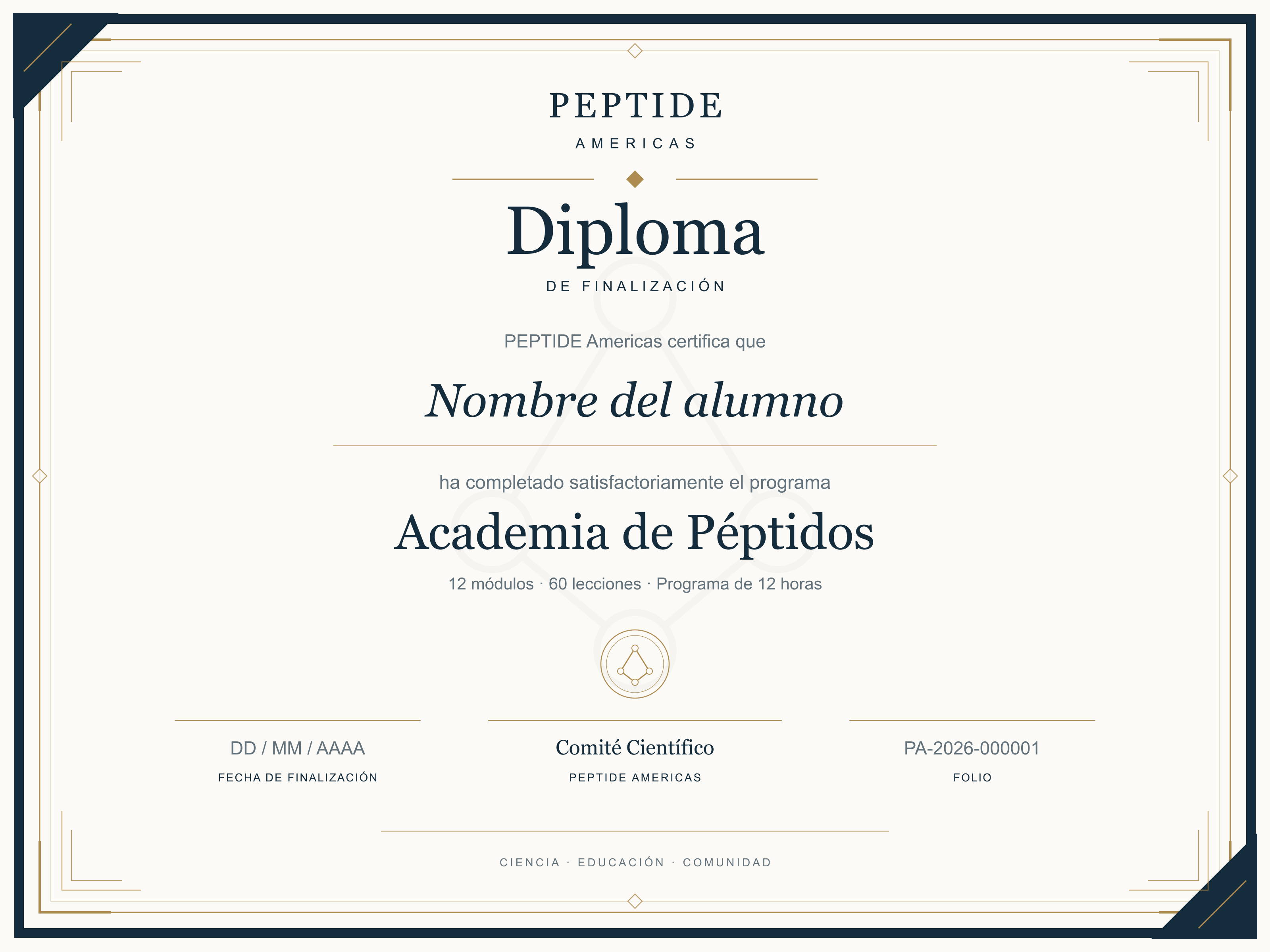 SAMPLE · UPDATED DESIGN
Downloadable completion diploma after finishing the course
Updated sample design for Academia de Péptidos. Both 12-hour diplomas with Scientific Committee attribution are saved in Kajabi for 100% completion. Previews are verified; real student delivery and download remain untested. No CME/CE accreditation or professional certification.
BEFORE YOU BEGIN
Healthcare professionals and adults interested in understanding peptide science. It includes scientific terminology and pharmacology. It does not require or confer a professional license.
One US$99 purchase includes the complete Spanish and English versions, with 12 modules and 60 lessons per language. The three current free sample lessons have Spanish audio.
Both complete Kajabi versions: 12 modules and 60 lessons per language, 120 video lessons total. Videos are published; scientific, medical and translation review remains pending. Enrollment is available through Kajabi.
Both diplomas are configured and saved in Kajabi for issuance at 100% course completion, with dynamic name, date and unique serial. Both language previews are verified; real student delivery and download have not been tested. They are not CME/CE accreditation, a license or professional certification.
The declared program duration is 12 hours, not a precise measurement of video runtime. The 12 hours are not continuing medical education credits.
One US$99 payment includes both languages and 12 months of access from purchase, without automatic renewal.
Request a full refund within 14 days of purchase by contacting our support team. Course access ends when the refund is issued. Reply to your purchase email. Refunds and automatic access revocation have not been tested.
Scientific education; not a substitute for medical consultation. Scientific and translation review pending. Read the planned terms.
ACADEMIA DE PÉPTIDOS